

 |
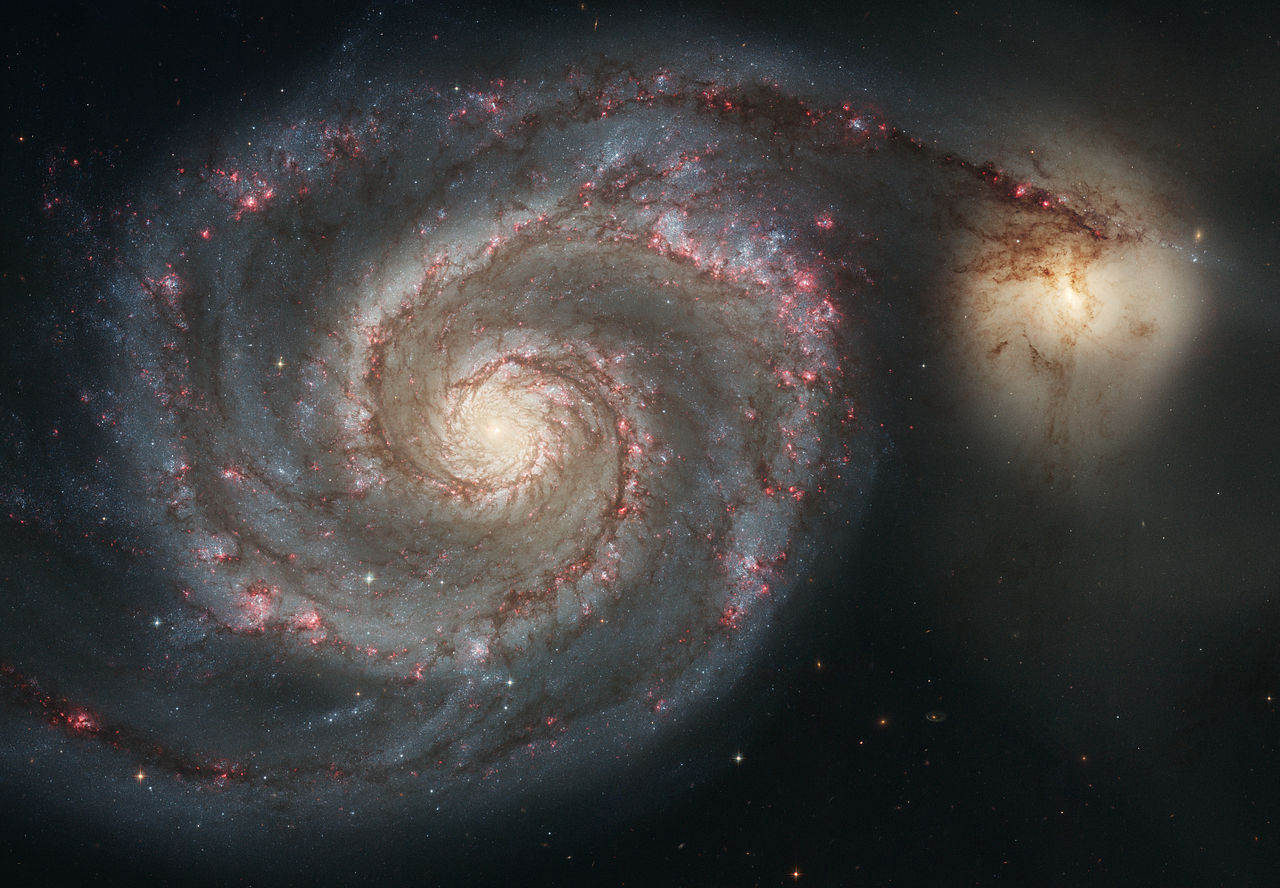
| The Whirlpool galaxy, as rendered by the Hubble Space Telescope |
Telescopes are a recent discovery; only 400 years old. The first type of telescope, a refracting telescope. was invented by Galileo Galilei in the year 1610. With the invention of the telescope, Galileo discovered the four biggest moons of Jupiter, called the Galilean moons in his honor. This was a major step to refuting the validity of the model of the Universe put forth by the Church and brought into light the Heliocentric model proposed by Nicolas Copernicus, a century back. Galileo also observed the moon through his telescope, as well as Venus and the Sun. He was first to note the phases of Venus as well as the sunspots on the surface of the Sun.
The reflective telescope was invented later on in the 17th Century by the legendary Sir Isaac Newton. It marked the beginning of a time where telescope power steadily increased from decade to decade. By the end of the 17th Century, some moons of Saturn had been discovered. This put the nails in the coffin as far as the Earth-centric model of the universe was concerned. This radically changed science and was the beginning of the scientific revolution.
Telescopes have been the most powerful tools of observing the cosmos ever since their invention. New and better telescopes are being built as we speak. In the near future, we hope to view some of the most distant objects in considerable detail using the telescope, as well as finding habitable planets orbiting other stars. All the discoveries in astronomy would have been impossible without the use of telescopes.
So, besides their enormous astronomical value, what use is a telescope to an average human? Well, it is one of the most humbling ordeals in human life to look at the heavens through a telescope, as I have experienced recently. You get to see tiny things appear so big that it feels as if the Universe itself has enlarged, giving the sense that your heart itself has become bigger. Telescopes have awed and inspired every new generation of people onto bigger and greater things.
Telescopes can be of all shapes and sizes. There are even some telescopes which specialize in frequencies invisible to our eyes! X-rays, infrared, ultraviolet, radio waves, gamma rays, microwaves are all cataloged according to the natures of different telescopes. The Hubble Space Telescope provides us with some of the most breathtaking photographs, due to its unique place in space, which negates the refractive bending of light by our atmosphere.
However, due to intense modernization and urbanization, the nights are becoming increasingly polluted by citylights. Its impossible to see the night sky proper in most of the major cities of the world. In the past, our relationship with the stars was much more personal. In modern times, however, their importance is diminishing. In fact, the invention of the telescope signaled the beginning of an era of modern development which in turn reduced the beauty of the night sky. Is the telescope really a messiah for improving our relationship with the stars, or is it a disguised villain?
 |
| The Hubble Deep field: A picture of distant galaxies |
Telescopes are not intrinsically good or bad, like any other tool made by humankind. The level of goodness depends on the way it has been used by humans. We have used telescopes quite admirably and as such, have redeemed themselves. As to the indirect effects of their inventions, they are not to blame, as they have provided a much better outlook into the cosmos than the bad that they have done.

 Bijaya's creations