To find out when galaxies came into existence, we have to take a journey back in time. Light, having only finite speed, requires time to travel from one point in space to another point. As a result of the expansion of the universe, light from distant parts is severely red-shifted, a phenomena analogous to the changing frequency of police sirens as the police car approaches and then reduces into the distance. Consequently, the further we are from a light source, the more back in time we observe. The more back in time we observe, the more the light has to travel and thus, the light is redshifted more. The degree of redshift is used to determine distances to the furthest objects in the universe. Using this technique, astronomers have determined that the farthest galaxy that has been seen thus far, is about 13.3 billion light years away. This also means that the object was formed 13.3 billion years ago, an incomprehensible length of time for us. Observing galaxies so far back in time gives us an idea of when galaxies began to form – about a few hundred million years ago after the big bang, which occurred about 13.6 billion years ago and heralded the beginning of our universe.
The early galaxies were tiny objects; the aforementioned galaxy, called GN-z11 is 25 times smaller than the Milky Way, which is of course our very own galaxy. However, star formation occurred at significantly larger rates in those times. Stars are formed when clouds of gas and dust collapse and become hot enough to undergo nuclear fusion. In galaxies of old, star forming materials were abundant, and the conditions ideal. Over time, the galaxy evolves. Gravity, the grand architect of the universe at scales comparable to the Solar System, as well as that of galaxies, forced these primordial galaxies together. Thus, the average galactic size began increasing. Most of the early galaxies were irregularly formed with no characteristic shape. However, over time, collisions between irregular galaxies began sculpting the wide variety of galaxies that we see today, from beautiful spiral galaxies, to giant elliptical galaxies.
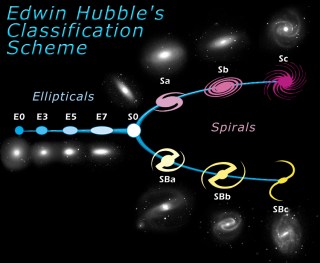 |
| Hubble’s Classification scheme of Galaxies |
Elliptical galaxies are the final galaxies on the evolutionary chain. With limited supply of gas and dust, most elliptical galaxies contain very few regions of starbirth and are generally occupied by old stars. The spiral galaxies are sort of the intermediates on the evolutionary chain. They contain appreciable quantities of gas and dust, while at the same time containing many old stars as well. There are many different types of spiral galaxies and although many of them look similar, no two spiral galaxies are the same. Irregular galaxies generally consist of vast quantities of gas and dust and have many star forming regions within them. The smallest galaxies are generally irregular; the largest ones are generally elliptical. Galaxy collisions sculpt existing galaxies into larger, diverse types. In fact, the Milky Way and Andromeda, a nearby spiral galaxy, are on a collision course and are expected to collide in a few billion years!
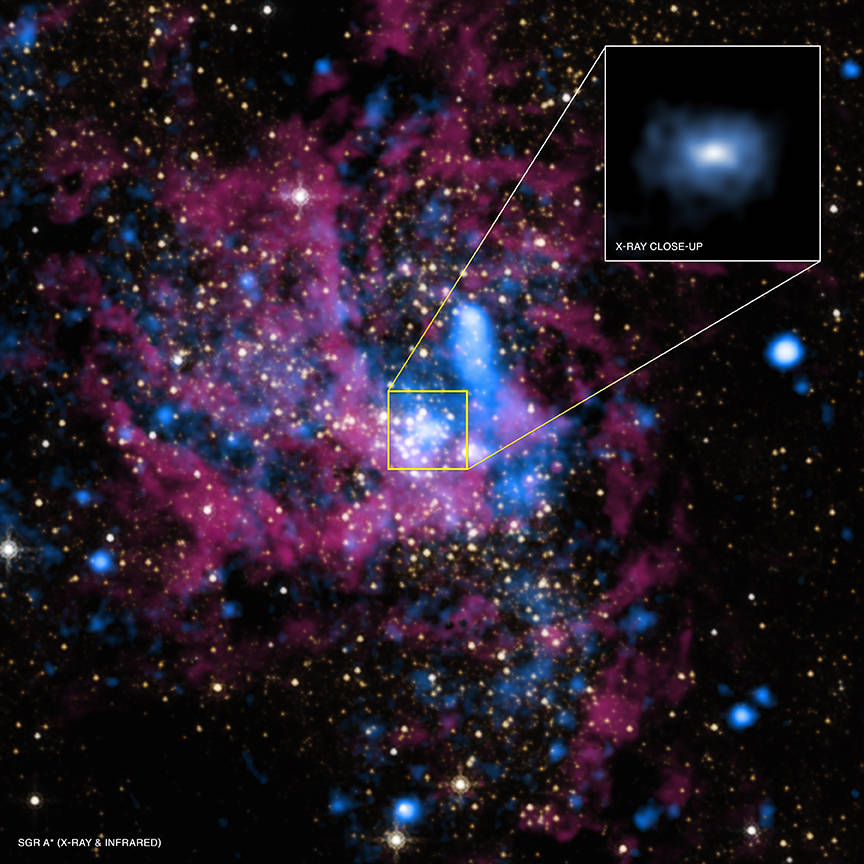
Another interesting feature of galaxies is the presence of supermassive black holes in the galactic centers. Supermassive black holes are found in the centers of almost all galaxies, with primordial galaxies and dwarf (small) galaxies being the exceptions. The presence of a supermassive black hole in a galaxy can be determined by analysing the spectra of galaxies. An interesting thing to note is the word “supermassive”. When we say that a black hole is supermassive, we mean that it contains the mass of millions of Suns! Black holes with masses only 10 or hundred times that of the Sun can also be formed. Such black holes are called stellar-mass black holes and are formed by the violent deaths of stars much more massive than the Sun. Some of the spectacular manifestations of early supermassive black holes include Quasars, which have luminosities hundreds of times that of the Milky Way galaxy.
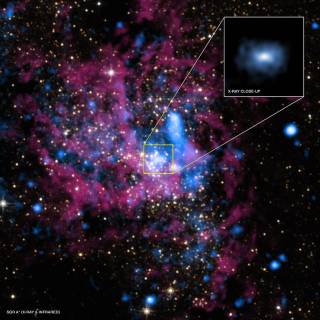 |
| Sagittarius A* in X-ray, which is the Supermassive black hole at the center of our galaxy |
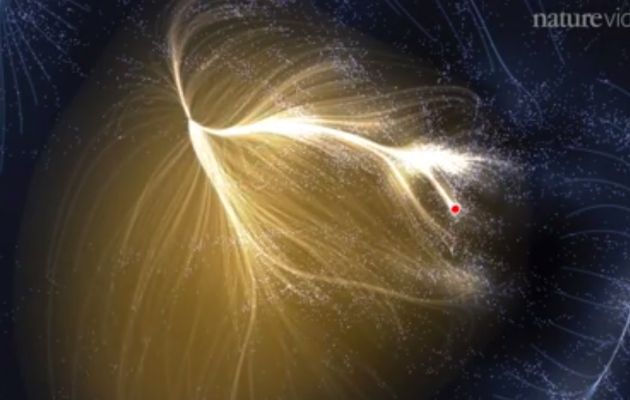
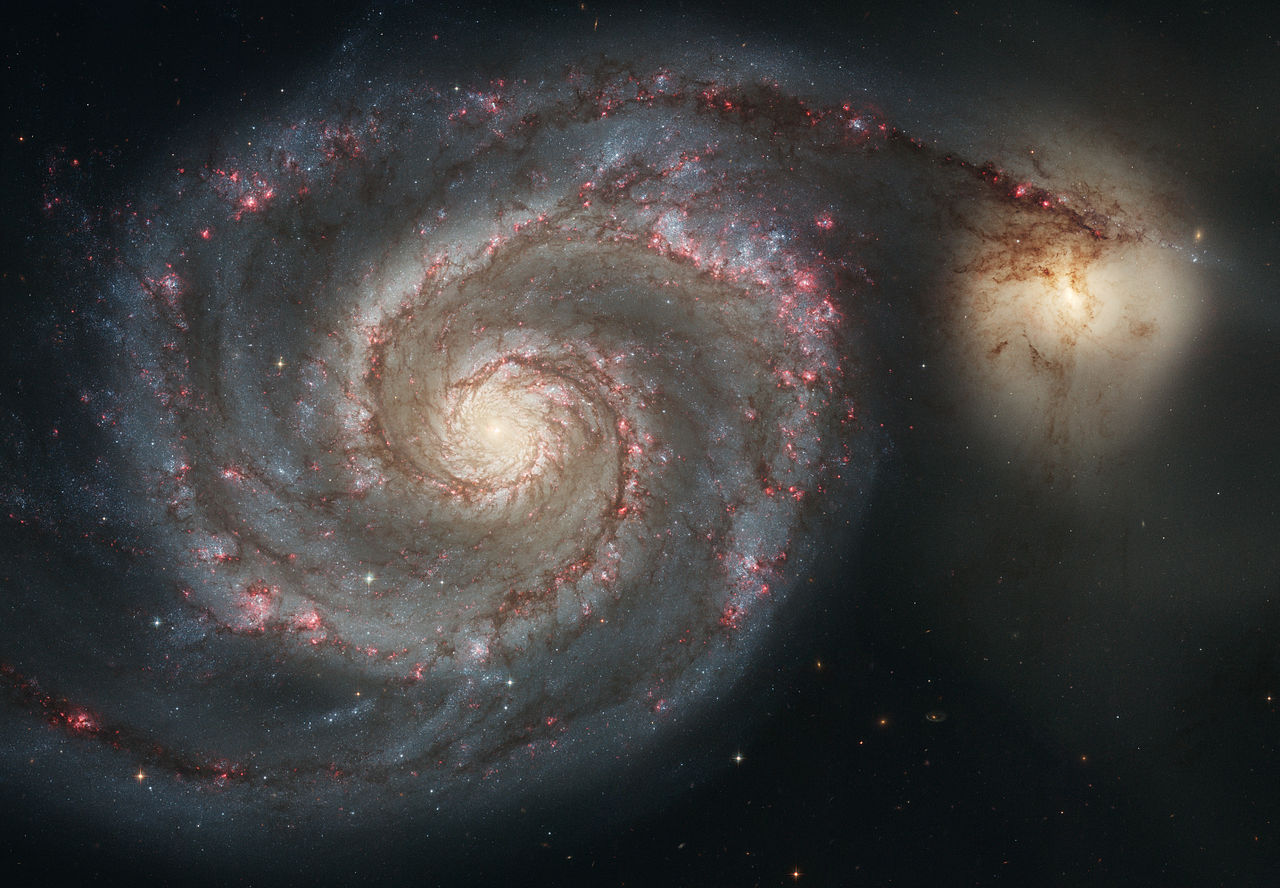
Some of us might think that galaxies are separate and interact only occasionally. However, that is not true at all. Galaxies are by no means lonesome objects. Like groups of islands existing nearby in the ocean, galaxies tend to come in clusters. The Milky way is a part of the “Local Group” of galaxies, which in turn is a part of the Virgo Supercluster, of which constituent galaxies can be seen mainly in the constellation of Virgo, the Virgin. The Virgo Supercluster itself if part of a larger extra-galactic structure called the Laniakea supercluster. Galaxy interactions are also perpetually occurring phenomenon. One need only look at pictures taken by the Hubble Space Telescope to know this!
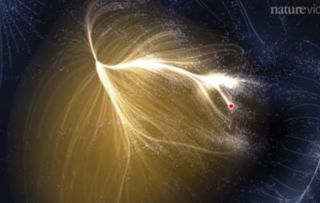 |
| The Lanikea supercluster |
One of the most foundation-shaking discoveries in physics came by studying galaxies. First of all, we need to be aware of the fact that stars, gas clouds, nebulae etc. in a galaxy orbit the galactic center, just like the planets in our solar system orbit the Sun. Since the law of gravitation is universal, one would expect stars more distant from the center to have lower orbital velocities. However, that is not the case. Stars orbit the galactic center of their respective galaxy at more-or-less equal velocities, which seems to contradict the known laws of physics. This was first discovered by Vera Rubin, when studying the Andromeda Galaxy. In order to reconcile the discrepancy between observation and theory, scientists offered an explanation. Galaxies contain not only luminous matter, i.e, matter that can be seen, but also non-luminous matter, which is matter that cannot be seen. This mysterious matter was called Dark Matter, and we call it such till today. Moreover, by studying recession speeds of the galaxies, it was determined that galaxies are moving away from each other at ever increasing rates! This required the introduction of a new type of material, called Dark Energy! Thus, galaxies have proven to be very useful objects to study, as their study has resulted in some ground-breaking new discoveries!
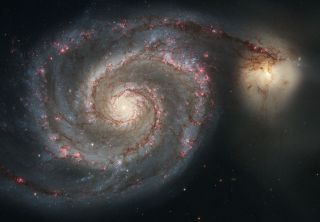 |
| The Whirlpool Galaxy (M51) in the constellation Canes Venatici |
Therefore, galaxies are unique, diverse objects that offer us plenty of insight into our universe. We have only begun to realize the importance of studying galaxies. There are a multitude of questions that need answering and in the case of some of these questions, we are nowhere near answering them. All this makes Galaxies very interesting objects with an important part to play in our pursuit of greater understanding of the universe.



 Bijaya's creations