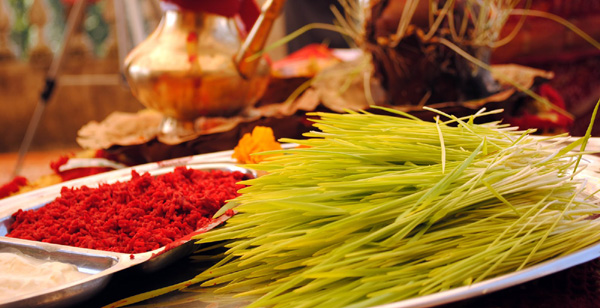
On a pleasant autumn evening, with the Sun hanging low in the sky, children with red “tikas” on their foreheads, green “jamaras” nestled on their ears, gleeful faces with tiny, silvery beads of sweat, could be seen flying wondrous square shaped objects called kites in the sky. What am I describing? They are the sights that greet us during the wonderful Hindu festival of Dashain, which has retained a special place in the hearts of every Hindu, and more so, me and my family, ever since a faithful day about 17 years ago.
First and foremost, what is Dashain? It is a 15-day festival marking the victory of good over evil, peace over war and togetherness over separation. The new moon of the 6th month on the Hindu calendar heralds the beginning of this auspicious festival, while the full moon at the end of the 15-day cycle marks its end. On the tenth day, the entire family gathers to put on “tika” and “jamara”; symbols of the family members’ love and affection towards each other. Dashain is well known, especially to the younger members of society, as a time for flying kites, as well as riding on traditional swings made of bamboo.
In more ways than one, the festival has shaped my identity and my life. I was born on the tenth day of Dashain, which is regarded as one of the most sacred days of the year. My parents befittingly decided to call me “Bijaya”, which in Sanskrit means victorious. Moreover, I was born just a short while after sunrise, thus increasing the sense of mysticism surrounding my birth. I couldn’t have hoped for a more kinder welcome.
Being born on such a special day presented me with a set of unique challenges. My family, deeply religious as they are, believed it signaled great things for me and for them. Ever since I was small, I can recall having to face the burden of overwhelming expectations. Having been named “victorious”, it felt only right to assume that losing in anything was never an option. Despite such predicaments, I still love the festival. Stick till the end, and you will find out why.
What does celebrating Dashain entail? Most people celebrate Dashain in their ancestral homes. However, due to the remoteness of my village, I have been unable to celebrate Dashain at my ancestral home. As a result, most of my Dashains have been spent at my “mamaghar”, the Nepali word which means “maternal uncle’s home”. Being unskilled at flying kites, I spent most of my time watching my uncles flying kites, at times trying to understand why the kites were able to fly while at others, just drinking in the beauty of the multi-coloured kites that were up in the sky. Unfortunately, I have never ridden a Dashain-styled swing, so I’m unable to describe how riding on a swing feels. However, judging by the looks of pure joy and ecstasy on the faces of people riding the swings, I surmise it must be a thrilling experience.
On tika day, the first thing I hear is “Happy Birthday!”. Along with the usual Dashain tika day celebration, which includes putting on tika and jamara as well as receiving the blessings of elders, there is also a celebration of my birthday. Every year, I receive great presents. It fills me with joy to enjoy my birthday on a day which is almost always pleasantly sunny. With golden leaves falling from nearby trees, as well as the snow-capped mountains that can be seen in the distance from the Kathmandu valley, along with the smell of fresh, mountain air and the delightful chirps of birds resting on trees nearby, you get an inkling of what heaven must be like. Putting on tika and jamara, surrounded by family amidst such a perfect environment fills my heart with love, warmth and happiness. It truly feels like the day of celebrating victory.
So far, I have described what Dashain means to me. In order to understand its greatness, its societal impacts need to be examined too. The festival epitomizes thoughts such as “Life is like a burning candle, enjoy it while it lasts” and “Some good can always be found in the bad”. It brings moments of joy to families that have been separated, either by choice or by the hard truths of life. It unites a community,a city, a region and a nation. The struggles, the demands and the less pleasant aspects of life are forgotten, albeit for only 15 days. Dashain has that incredible power of uplifting the emotions of large groups of people, which I feel is unrivaled.
At times, I admit, the festival of Dashain fills me with dread. What if I’m not victorious? What if I’m unable to achieve what I want to achieve? Doubts such as these always surface when I think about Dashain. Due to my unique relationship with this festival, these doubts are an inherent part of my Dashain experience. They are like dark patches of clouds on an otherwise clear and beckoning sky. Then there are those expectations that loom large; looking terrifying. However, before I;m rendered hopeless with negativity, I remember the basic premise of Dashain – the victory of good over evil, love over hatred and yin over yang. This fills me with hope and uplifts me. The self-doubts that are a part of my life due to the nature of my birth are cleansed by the festival itself. Neat, isn’t it?
Therefore, these are the reasons why Dashain retains a special place in the hearts of me, my family and society in general. I feel connected to the red tikas and green jamaras of Dashain. This is the reason why my first thoughts regarding Dashain are always tied to the colors red and green. For me, and I believe every person that has experienced this pristine festival first hand, Life without Dashain would be like the night sky without the moon.
First and foremost, what is Dashain? It is a 15-day festival marking the victory of good over evil, peace over war and togetherness over separation. The new moon of the 6th month on the Hindu calendar heralds the beginning of this auspicious festival, while the full moon at the end of the 15-day cycle marks its end. On the tenth day, the entire family gathers to put on “tika” and “jamara”; symbols of the family members’ love and affection towards each other. Dashain is well known, especially to the younger members of society, as a time for flying kites, as well as riding on traditional swings made of bamboo.
In more ways than one, the festival has shaped my identity and my life. I was born on the tenth day of Dashain, which is regarded as one of the most sacred days of the year. My parents befittingly decided to call me “Bijaya”, which in Sanskrit means victorious. Moreover, I was born just a short while after sunrise, thus increasing the sense of mysticism surrounding my birth. I couldn’t have hoped for a more kinder welcome.
Being born on such a special day presented me with a set of unique challenges. My family, deeply religious as they are, believed it signaled great things for me and for them. Ever since I was small, I can recall having to face the burden of overwhelming expectations. Having been named “victorious”, it felt only right to assume that losing in anything was never an option. Despite such predicaments, I still love the festival. Stick till the end, and you will find out why.
What does celebrating Dashain entail? Most people celebrate Dashain in their ancestral homes. However, due to the remoteness of my village, I have been unable to celebrate Dashain at my ancestral home. As a result, most of my Dashains have been spent at my “mamaghar”, the Nepali word which means “maternal uncle’s home”. Being unskilled at flying kites, I spent most of my time watching my uncles flying kites, at times trying to understand why the kites were able to fly while at others, just drinking in the beauty of the multi-coloured kites that were up in the sky. Unfortunately, I have never ridden a Dashain-styled swing, so I’m unable to describe how riding on a swing feels. However, judging by the looks of pure joy and ecstasy on the faces of people riding the swings, I surmise it must be a thrilling experience.
On tika day, the first thing I hear is “Happy Birthday!”. Along with the usual Dashain tika day celebration, which includes putting on tika and jamara as well as receiving the blessings of elders, there is also a celebration of my birthday. Every year, I receive great presents. It fills me with joy to enjoy my birthday on a day which is almost always pleasantly sunny. With golden leaves falling from nearby trees, as well as the snow-capped mountains that can be seen in the distance from the Kathmandu valley, along with the smell of fresh, mountain air and the delightful chirps of birds resting on trees nearby, you get an inkling of what heaven must be like. Putting on tika and jamara, surrounded by family amidst such a perfect environment fills my heart with love, warmth and happiness. It truly feels like the day of celebrating victory.
So far, I have described what Dashain means to me. In order to understand its greatness, its societal impacts need to be examined too. The festival epitomizes thoughts such as “Life is like a burning candle, enjoy it while it lasts” and “Some good can always be found in the bad”. It brings moments of joy to families that have been separated, either by choice or by the hard truths of life. It unites a community,a city, a region and a nation. The struggles, the demands and the less pleasant aspects of life are forgotten, albeit for only 15 days. Dashain has that incredible power of uplifting the emotions of large groups of people, which I feel is unrivaled.
At times, I admit, the festival of Dashain fills me with dread. What if I’m not victorious? What if I’m unable to achieve what I want to achieve? Doubts such as these always surface when I think about Dashain. Due to my unique relationship with this festival, these doubts are an inherent part of my Dashain experience. They are like dark patches of clouds on an otherwise clear and beckoning sky. Then there are those expectations that loom large; looking terrifying. However, before I;m rendered hopeless with negativity, I remember the basic premise of Dashain – the victory of good over evil, love over hatred and yin over yang. This fills me with hope and uplifts me. The self-doubts that are a part of my life due to the nature of my birth are cleansed by the festival itself. Neat, isn’t it?
Therefore, these are the reasons why Dashain retains a special place in the hearts of me, my family and society in general. I feel connected to the red tikas and green jamaras of Dashain. This is the reason why my first thoughts regarding Dashain are always tied to the colors red and green. For me, and I believe every person that has experienced this pristine festival first hand, Life without Dashain would be like the night sky without the moon.

 Bijaya's creations