A trip to the only science centre in Nepal sounds like a good idea, doesn’t it? That is what lay in store for 17 of us participating in a closed camp as part of the National Astronomy Olympiad; a trip to the Everest Science Centre. The trip lasted for a total of 3 days, during which we conducted an observation session as well as a theoretical classes. However, the trip was more about exploring the Everest Science Centre, which is situated near Biratnagar, a city in Eastern Nepal, and realising the importance of it in the contemporary sense for Nepal.
We left Kathmandu for Biratnagar on the 26th of August at 4pm. It took about 16 hours by bus to reach the Everest Science Centre, which, for me, felt like ages. The bus ride could be described as uncomfortable, mainly because of the bumpy roads. We stopped at various places to eat, some of which were pretty good, while others were execrable. For me, the most memorable part of the trip to Biratnagar was witnessing the majesty and serenity of the absolutely huge Koshi river for the very first time.
We arrived at the Everest Science Centre at about 9 am on the morning of 27th August. Each and everyone of us felt tired, as we had been unable to sleep properly on the bus. Right after we arrived, we took showers and sat down for breakfast. After breakfast, we took rest for some time. Thereafter, we visited the scientific exhibition, which contained a variety of machines and experiments. Some of the attractions there included a chamber full of mirrors, a model of the city of Hiroshima before and after the dropping of the infamous nuclear bomb “fat man”, four balls to depict the conservation of momentum and many more.
After visiting the Scientific Exhibition, we watched an animated movie in the 3D theatre that was present there at the Science Centre. The movie was soporific; almost everybody had fallen asleep after a while. After the movie show, we roamed around the science centre. It turns out that the Science Centre was also a picnic site, by the name of Shantiban. There were some slides, swings, see-saws and also a boat. However, I didn’t go boating there, simply because the river was very shallow, which put me off. After 5, we had a class on stellar and planetary physics. The questions were pretty easy, with topics such as albedo, luminosity, bolometric correction being discussed.
The main event took place at night. We took part in night-sky observation, which lasted for a total of about 4 hours. We learnt many new things from the observations, none more significant than using only red light to look at our sky charts. This is so, because our eyes are least sensitive to red light. After knowing some of these basic details, we started observing the skies. As part of the night sky observation, we looked at the planets that were visible (Venus, Jupiter, Mercury, Saturn and Mars), some deep sky objects, the constellations and even an iridium flare! An iridium flare is basically a phenomenon which occurs when a satellite, or a part of a satellite reflects tremendous amount of sunlight, making it appear as a bright star in the night sky for about 5-10 seconds. The skies in Biratnagar were brilliant and conducive to a successful night of night sky observations. For me, looking at the Andromeda galaxy through binoculars and looking at the majestic rings of Saturn through the reflector telescope there, were the most memorable moments of the night.
Most of the next day was about enjoying the Science Centre for the last time. The guy behind the whole initiative, Dr. Dilip Adhikari, gave a speech regarding when the Science Centre was formed and also about why it was important. He also talked about some of the events that the Science Centre had organized, including an exhibition of a rock brought back from the moon. Moreover, he talked about the visit of Buzz Aldrin, who is due to visit Kathmandu on the 8th of September. Listening to Dr. Adhikari was interesting, because he talked about some of the problems faced during the construction of the Science Centre, due to various political reasons. Moreover, he talked about the importance of developing a “feel” for Science in the Nepalese society.
With a lot of fond memories, including watching the others riding the boat and falling into the river, we bade farewell to the Science Centre at 2pm. From the Science Centre, we went to a resort near the city of Itahari, a 20 minute drive from Biratnagar. There, we rode a Ferris wheel and a ride called the Columbus. Both of them were great fun. Some of us also went boating. This time, I did take part in the boat ride, because the pond there was grander than the pond at the Science Centre. And that was that. After the visit to the resort, we returned to Kathmandu. We arrived in Kathmandu on the 29th of August, at about 10 am.
Therefore, the trip was about visiting the Science Centre and realising its importance. Being the only science centre in Nepal, the Everest Science Centre has huge burdens on its shoulders. However, it is my belief that with the advent of the “Science Centre movement” in Nepal, the future is bright for the Everest Science Centre and future Science Centres in Nepal.
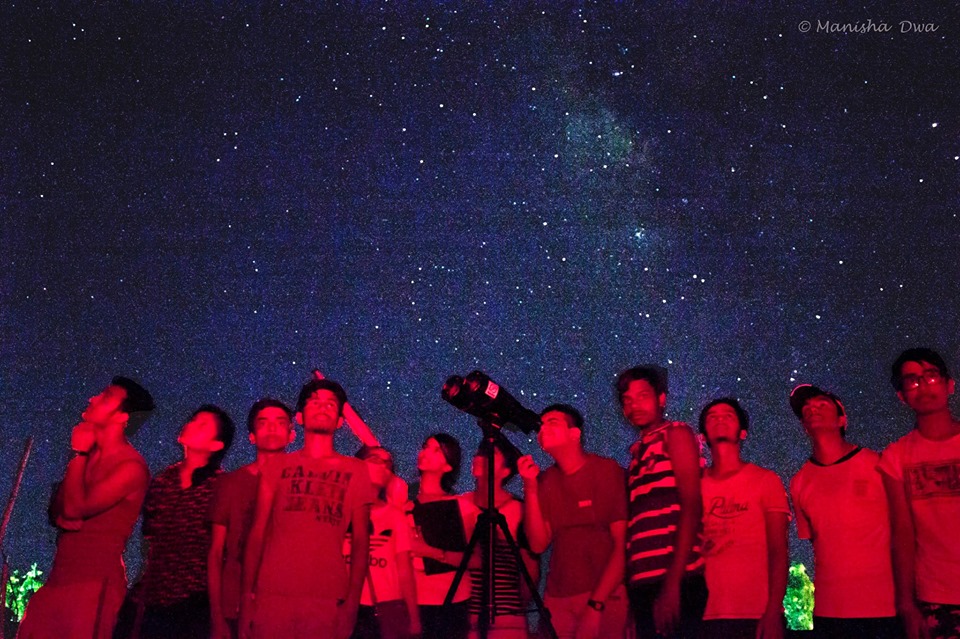 |
| A beautiful photo that contains the Milky Way in the background |

 Bijaya's creations