I begin this article by asking the most basic question one could ask about the topic at hand: What is the Roche limit? The Roche limit is basically the “maximum safety distance”. If any object strays inside the Roche limit of another larger body, then the object will be disintegrated. Take the case of Comet Shoemaker-Levy 09, a relatively large comet which was broken up into fragments by the planet Jupiter. The comet broke up, because it strayed inside the Roche Limit of Jupiter. In fact, there are many cases in the Solar System where the Roche limit comes into play, some of which many of us might never have considered!
 |
| Fragments of Comet Shoemaker-Levy 09 |
First and foremost, let us look at the history of the Roche limit. The Roche limit is named after a French astronomer named Edouard Roche, who published the first calculations of the Roche limit in the year 1848. Basically, there are different forms of the Roche limit, which take density factors into consideration. Take two satellites, of the same mass, but different densities. One is much more dense than the other. Which one do you think will be broken apart quicker if both of them happen to fall inside the Roche limit of their host planet? In fact, the distance of the Roche limit from the host planet varies in accordance with the density of the approaching smaller object. In fact, the Roche limit is calculated for two cases: a rigid body case and a fluid body case. A rigid body case assumes that the object is spherical in shape and is held together by its gravity. A fluid body cases assumes that there are no internal binding forces.
So now the question is, why does the Roche limit arise? Why do objects break apart anyway? Well, the answer to both these questions is the tidal force. The tidal force is so named, because it is responsible for the generation of tides in the oceans. So how do we visualize the tidal force? Well, consider this. The force of gravity is what we call an inverse-square law with distance. This is because, the strength of gravity reduces by 4 times if an object were 2 times further away from where it originally was. Consequently, there will be different magnitudes of gravitational attraction on the same object by a larger object, simply because, the strength of gravity varies over distance. This is responsible for generating the tidal force. When this tidal force is equally forceful in pulling a chunk of an object as that of the object’s gravity, we say that the Roche limit has been passed.
Another way of visualizing tidal forces involves black holes. Many of us have heard that if a person were to fall into a black hole, then he/she would flatten and turn into a spaghetti. Why is this even considered as viable? Due to tidal forces. The gravity of a black hole is so strong that there will be non-negligible differences in the force of gravity even over small distance changes, such as the difference in distance between the head and the feet from the center of the black hole. Consequently, the feet are attracted more and more, causing the spaghetti effect.
An interesting effect of tidal forces and the Roche limit is the occurrence of rings around planets. Saturn has by far the most majestic ring of any object in the Solar System, and this ring is theorized to have been a moon, which strayed far too close into Saturn (this claim has good grounds, because the rings lie within the Roche limit of Saturn). In fact, all the other planetary rings in the Solar System are most probably a direct consequence of the tidal force.
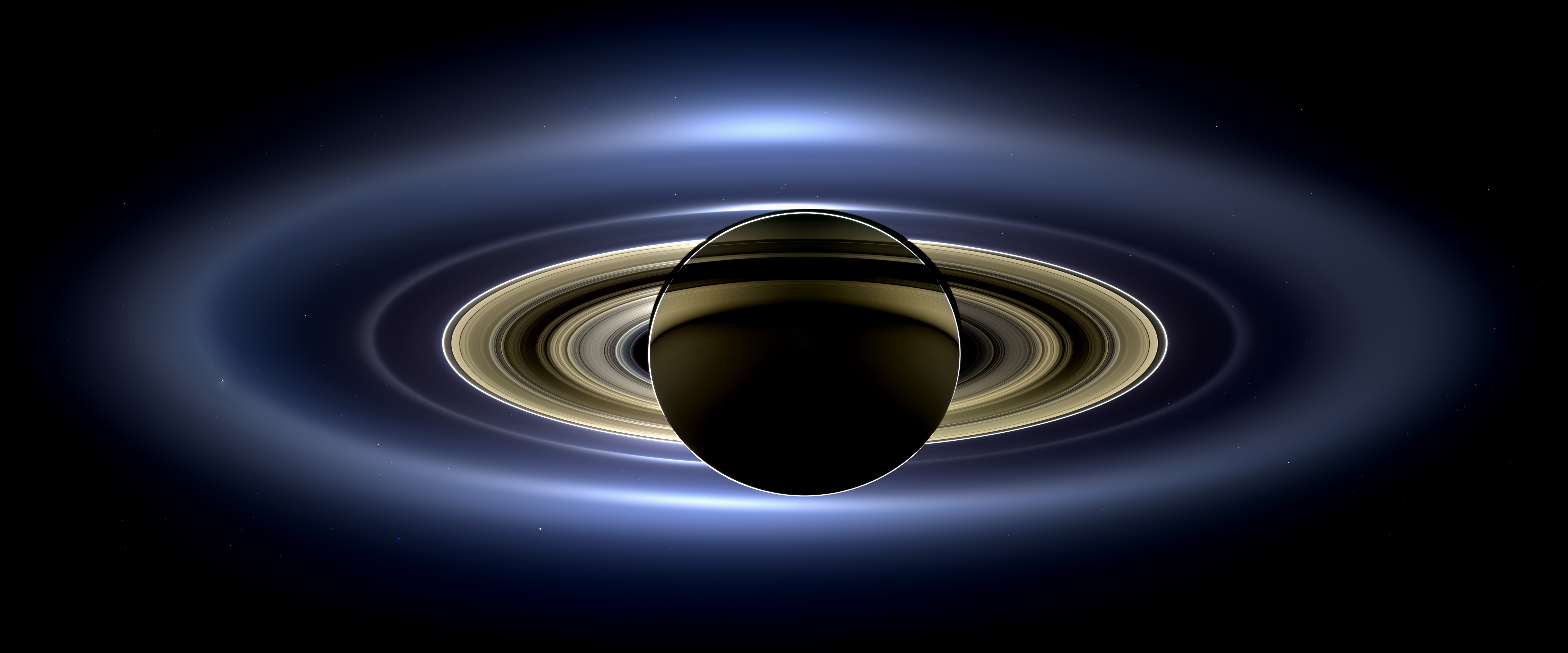 |
| The brilliant rings of Saturn were formed due to tidal deformation of a celestial body |
Now, with so much about the Roche limit under our belt, there might have been a lingering question bothering us throughout the entire article. How are artificial satellites kept intact, within the confines of Earth’s Roche limit (note that Earth’s Roche limit for rigid bodies is about 7000 km)? Well, satellites are held together not just by gravity, but by other means as well (since satellites are put together by welding and other processes, which are capable of withstanding much more stronger forces).
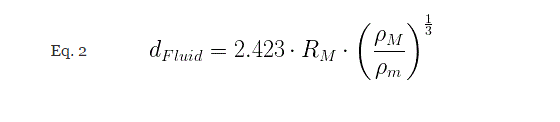
That is basically an overview of the Roche limit. The formula is given below, and it can be derived equating the tidal force on an object on the surface of a small celestial body with that of the force of gravity from the small celestial body.
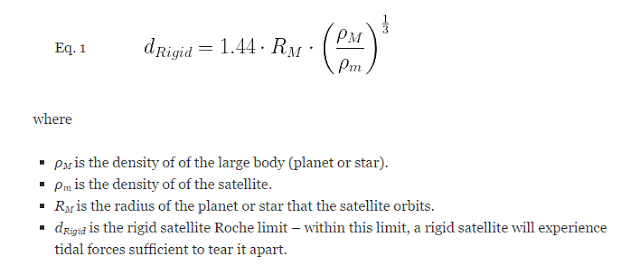 |
| Roche Limit for a rigid object. Source: http://mathscinotes.com/2016/03/roche-limit-examples/ |
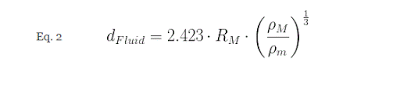 |
| Roche limit for a fluid object. Source: http://mathscinotes.com/2016/03/roche-limit-examples/ |
Thus, we can see that the Roche limit is a necessary tool to look at various phenomenon in the Solar System. In fact, one of the most interesting results of the tidal force is the fact that Phobos, a moon of the planet Mars, will break up within the 50 million years, because it is very close to Mars. The cosmos is much more interesting if basic concepts such as the Roche limit are known!



 Bijaya's creations