
“Nature and Nature’s laws lay hid in night: God said, “Let Newton be!”, and all was light”- Alexander Pope
These are incredible lines that were said about Isaac Newton, a reclusive dude from England who lived in the seventeenth and the early parts of the eighteenth century. In many cases, praise of people is sometimes unmerited. However, in the case of Isaac Newton, this praise by the Pope does not flatter him one bit.
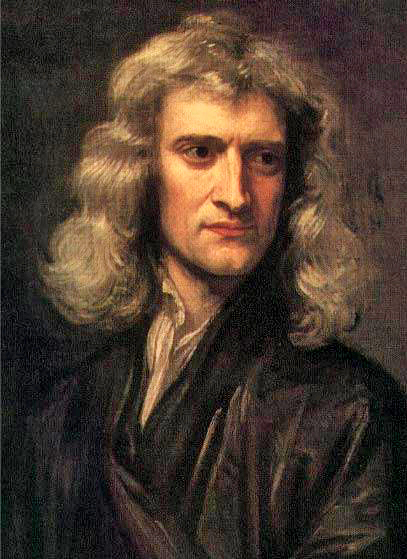 |
| Isaac Newton is a legendary figure in Mathematics and Physics |
Before the sixteenth century, Aristotle’s inquiries into the nature of motion were considered to be true. In those times, people believed that an object only moved if a “force” was applied on an object, and that the object came to rest because it had become tired. Moreover, the overwhelming consensus at the time was that the Earth was the center of the universe. All other celestial objects orbited the Earth. This way of thinking had gone unchallenged for centuries, specifically because this interpretation of the Universe was adopted by the church. Alternative proposals were discouraged, to such an extent that it was punishable to think anything other than what the church’s doctrine said.
However, a Polish priest called Copernicus came up with the idea that the Sun was at the center, not the Earth. But, he did not entirely denounce the geocentric viewpoint. He said that he had assumed the Sun to be the center, just to make the Math easier. After a few decades, Johannes Kepler came along and suggested that this was the true nature of the universe. He deduced that the planetary orbits must be elliptical, which he did by looking at the motions of the planets (in fact, there already existed an extensive sky catalog which had been made by Tycho Brahe). This contradicted the Copernican doctrine, because Copernicus had stated that the orbits were circular.
At the beginning of the seventeenth century, the development of the coordinate system by Descartes and the striking results of some wonderful experiments conducted by Galileo using inclined planes and pendulums, had resulted in a huge increase in the potential for discovering the laws of nature, which were extensively defined by the pair. All the work that had hitherto been done begged for a genius who had the capability of understanding nature very deeply.
Just as Galileo breathed his last, there came along a guy named Isaac Newton, who would later revolutionize the field of Science. Why is it considered a revolution? The concepts that Newton discovered would lead to the industrial revolution and also the space race! Applications of Newtonian Mechanics would lead to the contemporary world, in all its majesty and beauty. If there ever was a person who changed humanity the most by dishing out a book and working his entire life, it was Newton.
Newtonian physics is much simpler than contemporary theories such as Quantum Theory o General Relativity. While Newtonian physics cannot account for some of the weird phenomena that occur at the sub-atomic level, or the effects of travelling near the speed of light, it still provides a great tool for physics on the Earth, Consider this, would it be easier to solve Newton’s Universal Law of Gravitation or Einstein’s field equations for General Relativity?!
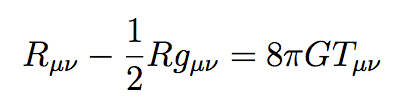 |
| Would you want to solve this (by the way, there are other equations for the components of this equation!)? |
Thus, Newtonian Physics is simple, yet beautiful. It does not require a great deal of mathematical manipulation; yet it has the capability of describing the world around us NEARLY perfectly. I would like to stress the word “nearly” though.

 Bijaya's creations