
So, as a tribute, I am going to be writing about some big contributions by women in the sciences. In the past, science, just like pretty much everything else was a male-dominated world (it is, to a certain extent, still male-dominated, but it has become better for women in recent times). However, some important breakthroughs in science were made by women. One of the main names associated with women in science is Marie Curie.
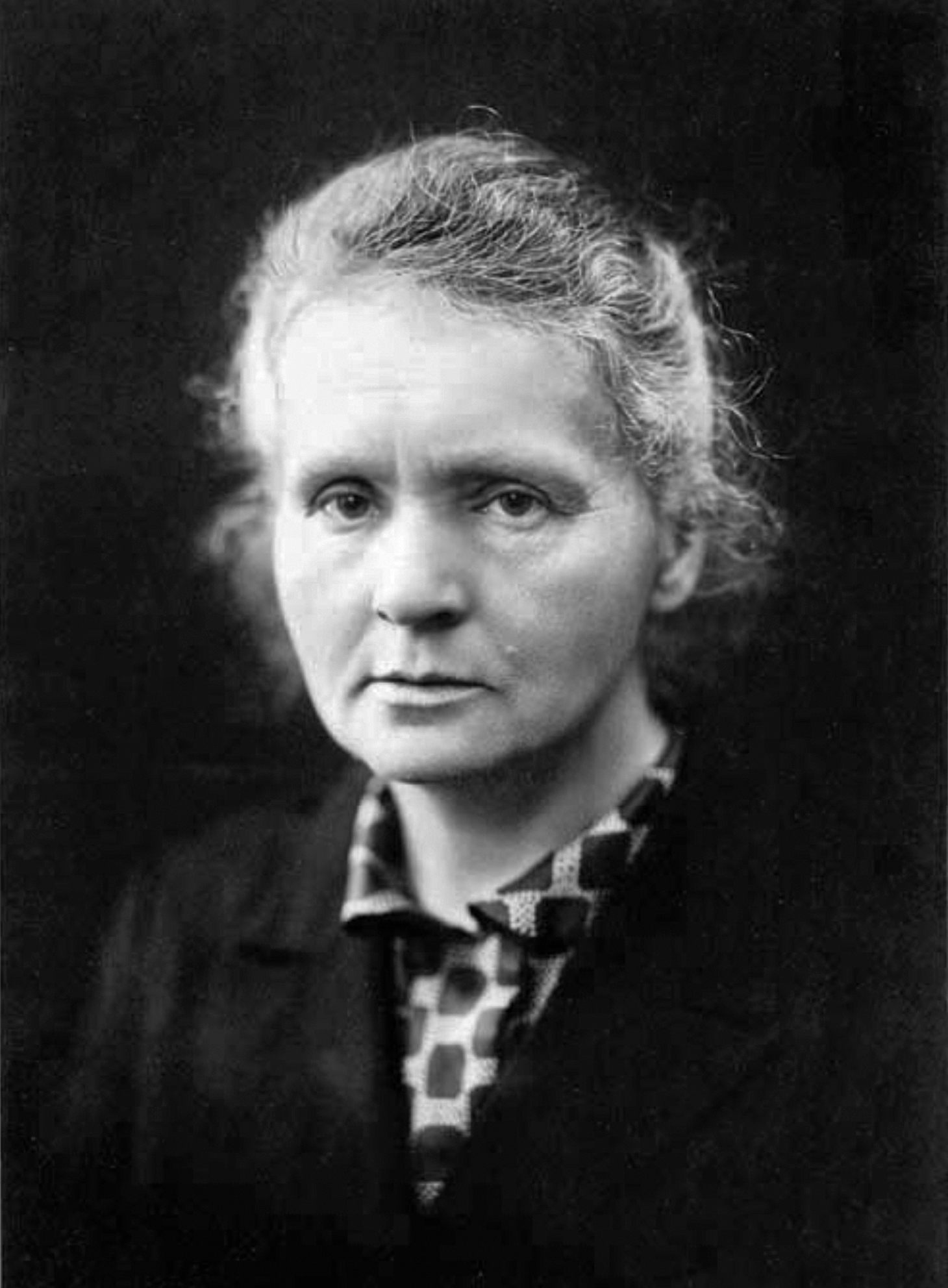 |
| Marie Curie |
Marie Curie won two Nobel prizes, the 1903 Nobel prize in physics and the 1911 Nobel prize in Chemistry, for co-discovering radioactivity and for isolating radium respectively. Unfortunately, Marie Curie died as a result of radioactivity poisoning. But, her contributions to atomic physics will cement her name as one of the greatest scientists born in the 19th century. Oh and there’s the fact that she is the only person to win a Nobel Prize in both Physics and Chemistry. (John Bardeen has won two Physics prizes).
Next we move on to Lady Ada Lovelace. She is widely considered the first programmer. She is known mainly for her work regarding the Analytical Engine, one of Charles Babbage’s computers (the other one being the Differential Engine). She was the first person to write an algorithm for a machine to use, and is thus, widely considered one of the first programmers.
In the field of astronomy and astrophysics, many women have made contributions. Henrietta Swan Leavitt discovered the relation between the Luminosity and time period of Cepheid variable stars, a class of stars that undergo variations in their luminosity and radius over short periods of time. Such stars are used to measure vast distances, such as distances between galaxies. Anne Jump Cannon is credited with discovering the Harvard system of classification of stars based on the spectra – the M, K, G, F, A, B, O scale. Cecilia Payne used this information to prove that stars were composed of mainly Hydrogen and Helium. Katherine Johnson also deserves a special mention. She calculated the trajectories for important NASA missions in the past, such as the Apollo 11 mission (which landed humans on the moon for the very first time). Another interesting woman in science is Mayim Bialik, the actress who plays Amy Farrah Fowler in the Big Bang Theory. She is in fact, a real life neuroscientist with a PhD!
I am unable to mention the other charismatic women who have helped bring STEM forward (I’m especially sorry for not mentioning any biologists, as I do not have much in-depth knowledge in the field of biology!). Nonetheless, their contributions should not be forgotten. In a modern technological era, the participation of women in the sciences is of utmost importance.
 |
| Nancy Roman |

 Bijaya's creations