
The long awaited transit of Mercury has arrived. The transit will start at about 11:15 GMT, which is 7:18 EDT, and 17:00 here in Nepal. The transit will take place for 7 and a half hours, and only a small part of the transit will be visible here in Nepal. In fact, the entire world besides Oceania and some parts of East Asia will have transit visibility, at least for some time. Here, in Nepal, the transit will be visible for about two hours, because the sun will set at around 6:37 pm. The entire transit will be visible from the East coast of the United States, Western Europe, some parts of Africa and virtually the whole of South America.
In order to view the transit ourselves, we require a telescope and also a filter to reduce the intensity of the Sun’s rays. The transit won’t be visible to the naked eye. Thus, people should refrain from looking directly at the Sun. For those who want to follow the transit, but do not have any means available to them, a live stream will be added by both NASA and Slooh, which I will embed a few hours before the transit occurs.
In order to view the transit ourselves, we require a telescope and also a filter to reduce the intensity of the Sun’s rays. The transit won’t be visible to the naked eye. Thus, people should refrain from looking directly at the Sun. For those who want to follow the transit, but do not have any means available to them, a live stream will be added by both NASA and Slooh, which I will embed a few hours before the transit occurs.
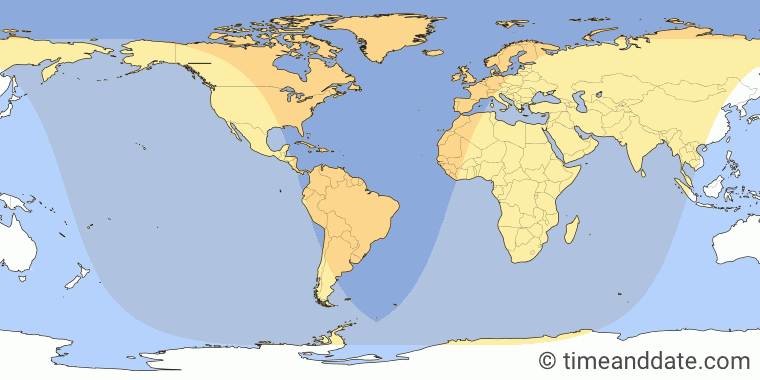 |
| Picture taken from timeanddate.com. The darker region indicates the places where the entire transit is visible. The lighter region indicates the places where the transit will be visible partially. The region which is not shaded at all represents the places where the transit is not visible in any form. |

 Bijaya's creations