
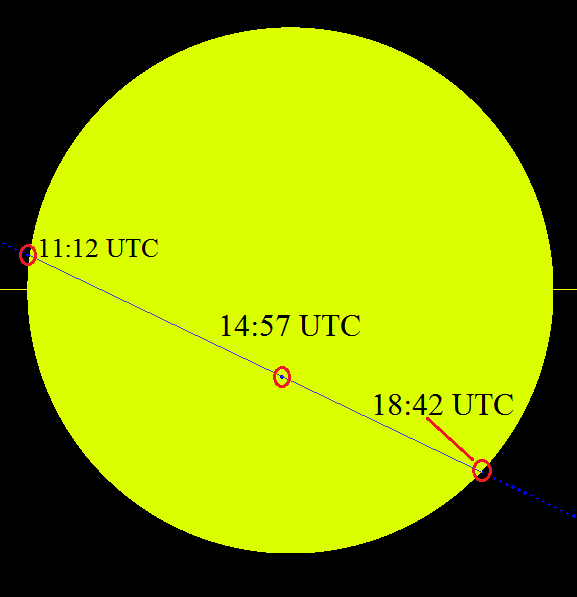
A planetary transit is always an exciting event. For those of you who don’t know, a planetary transit is a phenomenon where a planet passes in front of the disc of its star which can be detected on Earth. The latest planetary transit involved the planet Venus, and it took place on June 5th and 6th in 2012, for a duration of about 7 hours.
The next transit involves the planet Mercury, and will take place on May 9th. Transits of Mercury are much more frequent that Venus. This is because, Mercury is much closer to the Sun and also because of this close orbit, it completes one orbit much faster than Venus. However, since Mercury is only one third the size of Venus, and is farther away. Venus transits are much more spectacular. Only transits of Mercury and Venus can be seen, because the other planets are farther away from the Sun than the Earth.
Nonetheless, transits of Mercury are also beautiful spectacles. It is visible from all parts of the world, except South-East Asia and Australia (that’s a bummer!). It will start at 11:12 UTC and end at 18:42. A transit cannot be seen with the naked eye, so for members of the general public, it is much better to look for updates on the Internet!
Mercury transits occur in May and November, as a result of its orbit. November orbits are more common, as in such transits, Mercury is at perihelion whereas in May, Mercury is at Aphelion. Perihelion refers to the closest possible distance to the Sun in the orbit of a Solar system object and Aphelion is the farthest possible distance to the Sun in the orbit of a Solar System object.
Look out for my next article, which is going to about planetary transits in general, and it turns out that this phenomenon is used for detecting exoplanets!

 Bijaya's creations