
 |
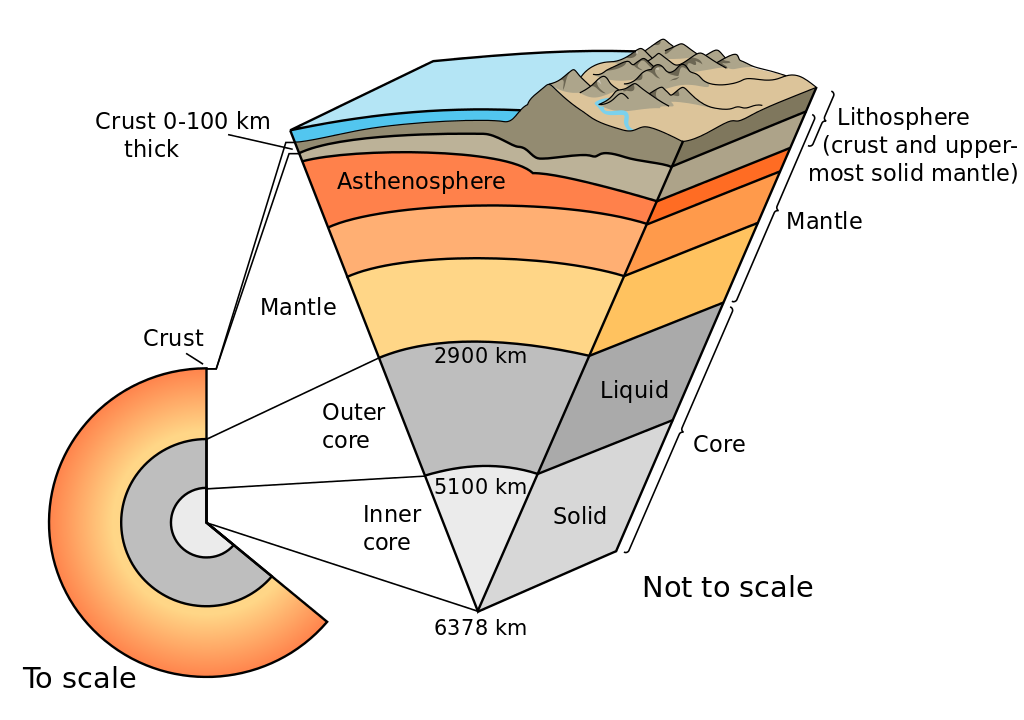
| A schematic diagram depicting the Asthenosphere in relation to the internal make-up of Earth |
The Asthenosphere is one of the upper layers of the mantle and is viscous, mechanically weak and ductile. It forms the upper part of the mantle, thus being a part of the boundary between the Lithosphere at the top and the Mantle below. The Asthenosphere occurs at varying depths, from 80 km deep to 200 km deep on average. In some places however, the Asthenosphere extends to more than 700 km (the subduction zone between the Japanese plate and the Philippine plate).
In the Asthenosphere, seismic waves travel slower than in the Lithosphere. The boundary between the Lithosphere and the Asthenosphere is taken where the temperature reaches 1300 degrees Celsius. the part above this boundary is hard whereas below this boundary it is ductile.
The interesting thing about the Asthenosphere is that although the Asthenosphere is ductile and mechanically weak, Earthquakes with foci in the Asthenosphere can occur. They are called deep focus Earthquakes (or intermediate focus earthquakes, if they are found in the upper regions of the Asthenosphere). Asthenosphere earthquakes, by virtue of their deep foci, can be felt over a wide geographical area.
A classic example of an earthquake that was focused in the Asthenosphere was the May 30 7.8 Magnitude earthquake offshore Japan, which took place at a depth of circa 660 km. Testimonies on the EMSC website told us that this earthquake was felt in distant areas like India as well. The largest earthquake that took place at such great depths was the Sea of Okhotsk earthquake in 2013, which was a 8.3 magnitude event.
In conclusion, the Asthenosphere is a very interesting part of the Earth’s geological make-up.

 Bijaya's creations