
 |
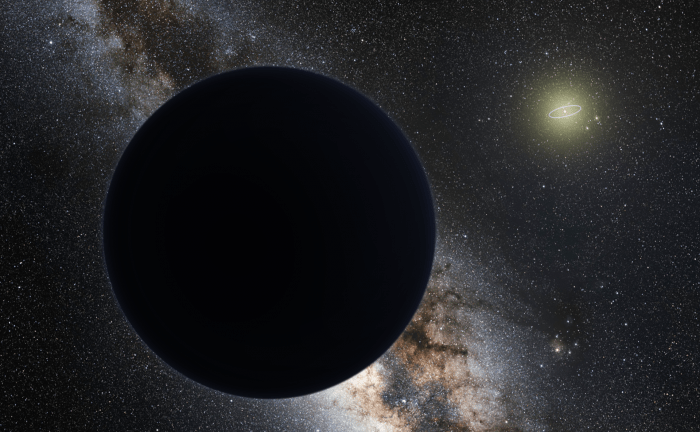
| An artist’s impression of Planet Nine, with the orbit of Neptune in a ring. Credits: ESO/Tomruen/nagualdesign |
NASA has documented slight perturbations in the orbit of Cassini, a space probe which is currently in its 12th year in orbit around Saturn. The gravitational forces accounted by the eight known planets in the Solar System do not add up to the observed orbit of Cassini. This has led to researchers stating that these perturbations may be due to the not yet verified Planet “X”, which is hypothesized to be orbiting the Sun beyond the orbit of Neptune.
In January, scientists had announced that there might be another Gas Giant beyond the orbit of Pluto, but this planet’s existence has yet to be conclusively proven. The researchers cited the strange behavior of some KBOs (Kuiper Belt Objects, the Kuiper Belt is a swarm of comets beyond the orbit of Neptune) in their orbits as the reason why they think there is another massive planet out there. Fast forward to April, scientists are now trying to put the pieces of the Jigsaw puzzle together.
By modelling the differences between the actual orbit of Cassini and the orbit predicted by the existing model of Solar System planets, scientists have determined that the theoretical prediction of Cassini’s orbit would match observation if the planet is located about 600 AU in the constellation Cetus. It is predicted that the planet is 4 times bigger than the Earth and 10 times as massive.
Until the planet is directly observed, or some conclusive evidence regarding its existence is found, there will be skeptics. However, scientists believe that a confirmation of the planet’s existence is not out of the question in the future.

 Bijaya's creations