
The press conference was over some time ago and the headline is this: the Martian atmosphere has been stripped away by solar winds. The MAVEN spacecraft, in orbit around Mars, has identified this process of stripping, which has played a substantial role in turning Mars from a habitable planet which was warm and wet to the cold, barren desert it is today.
It was long suspected that the Solar wind strips off the Martian atmosphere. However, the MAVEN spacecraft has actually been able to measure the rate at which this is happening, about 100 grams every second! This theory is also backed up by the fact that during Solar storms, much more of the atmosphere appears to escape.
The Solar wind is the continual ejection of photons, electrons and other charged particles from the Sun. When a planetary atmosphere comes in its path, one which is not shielded by a magnetic field, the charged particles excite the upper atmospheric particles, giving them enough momentum to attain escape velocity and leave the gravitational pull of the planet.
It was long suspected that the Solar wind strips off the Martian atmosphere. However, the MAVEN spacecraft has actually been able to measure the rate at which this is happening, about 100 grams every second! This theory is also backed up by the fact that during Solar storms, much more of the atmosphere appears to escape.
The Solar wind is the continual ejection of photons, electrons and other charged particles from the Sun. When a planetary atmosphere comes in its path, one which is not shielded by a magnetic field, the charged particles excite the upper atmospheric particles, giving them enough momentum to attain escape velocity and leave the gravitational pull of the planet.
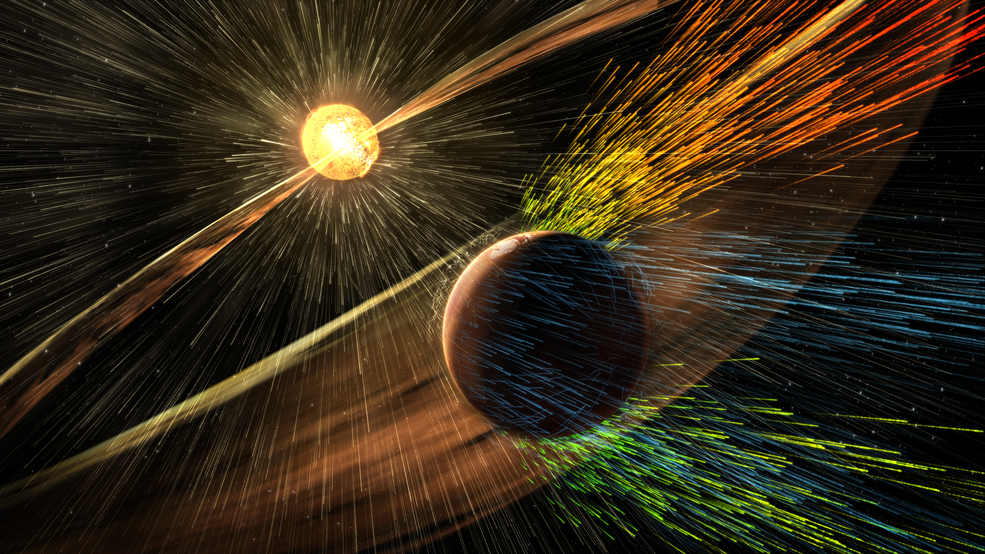 |
| Artist’s impression of a Solar Storm hitting Mars and stripping ions away Credits: NASA/GSFC |
There are features on the surface of the red planet which indicate that liquid water was abundant in it’s past. This points to the fact that Mars might have had a substantial atmosphere in the past and also might have supported life. Unfortunately, stripping in the past would have been much higher; stars at a young age tend to be much more active than older ones.
This research is essential if we want to land a human being on Mars later on in the century. NASA is embracing this possibility; it has announced recruitment of more astronauts. These are exciting times and data like this from the orbiters and landers on Mars is crucial to our understanding of the red planet’s history and geology.

 Bijaya's creations