
Stars are really far away. Calculating the distances to these celestial bodies is no cup of tea. However, approximations to their distances can be made. It involves a principle which most of us observe during our lives, but one which most of us ignore. It’s the awesome power of parallax.
Parallax is easy to picture. Just hold a spoon at arm’s length away from your eyes. Close one eye and look at the spoon. Then, open the other eye and close the open one and see the spoon again. The spoon will have moved a bit in comparison with the background, which is more distant than the spoon. This “change” across the background is exactly what astronomers use to calculate the distance to the stars.
Distances can also be estimated with the help of Luminosity and the star’s spectral class. However, this isn’t to reliable, mainly because many stars are variable, have superflares and also because there is a wide range of luminosity that a star of a certain spectral class can take. So, parallax is the preferred option.
The history of stellar parallax is very important in understanding why there was so much backing for the geocentric model (literally, Earth at the center). One of the expected consequences of the Heliocentric model was stellar parallax. But, such parallaxes could not be observed until the 19th Century, when Frederick Bessel measured the parallax of the star 61 Cygni. This “absence” of parallax opened up a great hole in the model and therefore many people still used the geocentric model up till the time when stellar parallax was first observed.
So, now that we have a little background about what parallax is, how do modern day astronomers do it? A spacecraft called the Hipparchus was launched in 1989 to catalog the stars. It used parallax to calculate the distances. Since the stars are so distant, you need a lot of distance between two observations to have any chance of observing parallax. For this, we measure the postition of the stars relative to the background at two opposite points on the Earth’s orbit, to increase the distance between the observations.
Such measurements of the parallax are so small that each star has a parallax less than 1 arc-second (for a sense of scale, there are 60 arc-seconds in 1 arc-minute and 60 arc-minutes in 1 degree!). So, as we move onto measuring the parallaxes of distant stars, it becomes more and more uncertain.
Is there a simple formula for parallax? Yes, there is. I’m going to present you two formulas; both of them work. But, firstly, we need to visualize what we are trying to calculate.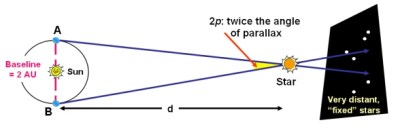
Parallax is easy to picture. Just hold a spoon at arm’s length away from your eyes. Close one eye and look at the spoon. Then, open the other eye and close the open one and see the spoon again. The spoon will have moved a bit in comparison with the background, which is more distant than the spoon. This “change” across the background is exactly what astronomers use to calculate the distance to the stars.
Distances can also be estimated with the help of Luminosity and the star’s spectral class. However, this isn’t to reliable, mainly because many stars are variable, have superflares and also because there is a wide range of luminosity that a star of a certain spectral class can take. So, parallax is the preferred option.
The history of stellar parallax is very important in understanding why there was so much backing for the geocentric model (literally, Earth at the center). One of the expected consequences of the Heliocentric model was stellar parallax. But, such parallaxes could not be observed until the 19th Century, when Frederick Bessel measured the parallax of the star 61 Cygni. This “absence” of parallax opened up a great hole in the model and therefore many people still used the geocentric model up till the time when stellar parallax was first observed.
So, now that we have a little background about what parallax is, how do modern day astronomers do it? A spacecraft called the Hipparchus was launched in 1989 to catalog the stars. It used parallax to calculate the distances. Since the stars are so distant, you need a lot of distance between two observations to have any chance of observing parallax. For this, we measure the postition of the stars relative to the background at two opposite points on the Earth’s orbit, to increase the distance between the observations.
Such measurements of the parallax are so small that each star has a parallax less than 1 arc-second (for a sense of scale, there are 60 arc-seconds in 1 arc-minute and 60 arc-minutes in 1 degree!). So, as we move onto measuring the parallaxes of distant stars, it becomes more and more uncertain.
Is there a simple formula for parallax? Yes, there is. I’m going to present you two formulas; both of them work. But, firstly, we need to visualize what we are trying to calculate.
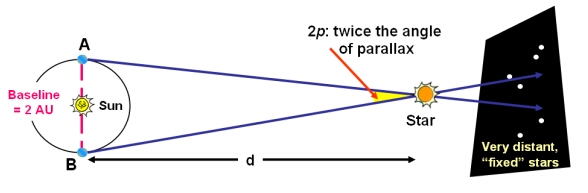
In this illustration, courtesy of Swinburne University, the method of parallax is shown. The distance between A to the star and B to the star is nearly equal. So, we can assume that the triangle formed by A,star and B is an isosceles triangle. We can then draw a perpendicular SD from the star on AB. The distance AD will be equal to BD and the angle ASB will be bisected by the perpendicular (properties of isosceles triangles). Now, we can use a bit of trigonometry to calculate the distance using the angle of parallax. Since, ASB was =2p, angle BSD will be equal to p.
tan P = opposite side to p/adjacent side to p
or, tan P= BD/DS
Therefore, DS= BD/tan P
Therefore, Distance= 1 AU/tan parallax angle
If you want, you can convert the parallax angle to degrees and find the light years by using the speed of light and so on. But, for the sake of simplicity, if you input the parallax angle in arc-seconds into this formula, you will get the distance in parasecs, which is a measure of distance that is equal to approx. 3.26 light years. This is the formula for measuring in parasecs:
Distance=1/parallax angle
I hope that was educational. If you have any queries, feel free to comment.

 Bijaya's creations