
General relativity, as I have said earlier, is one of the masterpieces of Albert Einstein. According to him, gravity is not a force, but a fundamental part of the interaction between spacetime and mass. General relativity predicts that spacetime is flat in the absence of matter. However, if mass is present, it curves space-time! So, the reason why the Earth orbits the sun, or why the moon orbits the earth, is the fact that these objects try to move in straight lines, but can’t, due to the geometry of spacetime.
It’s a compelling idea. But is it true? Till date, all predictions of general relativity, bar gravitational waves, have been detected, and these include some pretty weird phenomena such as lensing, black holes, time dilation and much more! (Details in my previous post regarding relativity).
Stepping aside gravity, let us turn our attention to electromagnetism. It is the force where charges are taken into consideration. Positive charges attract negative charges and vice versa, while positive charges repel positive charges and so do negative charges. It also includes the phenomena of magnetism, which was discovered to be related to the electrical force by Faraday.
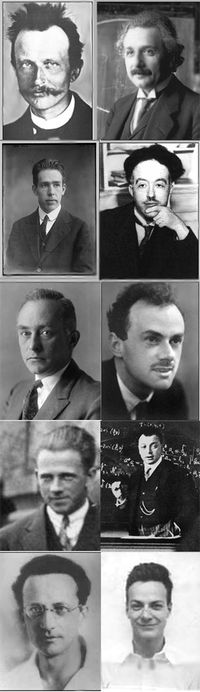 |
| Max Planck, Albert Einstein, Niels Bohr, Louis de Broglie, Max Born, Paul Dirac, Werner Heisenberg, Wolfgang Pauli, Erwin Schrodinger and Richard Feynman; the masters of Quantum Mechanics |
The classical theory of electromagnetism was given to us by great theoretical physicist James Clerk Maxwell, who based his theory upon the experimental observations of Michael Faraday. He was the first one to prove that light is an electromagnetic wave and also stated that light moves at exactly the same speed, regardless of what the state of motion of the body that emitted the light is.
Today, however, we have a more up-to-date theory of electromagnetism, which was devised by another great scientist- Richard P. Feynman, whose diagrams are still of great importance in quantum mechanics. This is a quantum theory of electromagnetism, and was united with the weak force to create a theory for the force called the electroweak force. This is a part of the search for a unified theory and is called a Grand Unified Theory. More on that later.
 |
| Grand Unified Theory in a nutshell |
The weak force, or the weak nuclear force, is the force responsible for radioactivity. It is one of the least understood forces among the three. A quantum theory of the weak force is there, which was later integrated with that of the electromagnetic force.
The strong nuclear force is the force responsible for binding the nucleons (neutrons and protons) together. It is also responsible for binding the quarks inside the protons and neutrons. The strong nuclear force, as its name suggests, is the strongest force among the three, which is very very very strong compared to the force of gravity. However, its influence is only on the nuclear level, as its effects tend to neutralise when bigger size scales than the nucleus are taken into consideration. There is also a quantum theory for the strong nuclear force, which is called Quantum Chromodynamics.
Modern physics is seeking a way to combine all these forces (excluding gravity) into a unified theory, that could explain how the forces came to be after the big bang. It is hypothesized that a single Superforce existed momentarily after the big bang and that gravity was the first force (not a force according to general relativity) to be separated. The next force to be separated was the strong force and the electroweak force soon after separated to become the forces that we are familiar with in today’s world. This is called the Grand Unified Theory.
According to the standard model, all these forces should have particles which carry the force. For the electromagnetic force it is the photon, for the weak force it is the W and Z bosons, for the strong force it is the gluon, and gravity is hypothesized to be carried by the graviton. The graviton, however, has never been observed before and there is weak scientific evidence to back it’s existence.
Since General Relativity and quantum mechanics are incompatible, a quantum theory of gravity is required if one is to unite all the forces into one. However, this is easier said than done. Scientists estimate that quantum gravity, even if a theory is discovered, will be too complex to have any testable details. However, it may also be that gravity is a fundamental property of spacetime that cannot be considered a force, which Einstein considered. It is a question that one can ponder on all through the night..
 |
| How new particles are discovered |

 Bijaya's creations