
 |
| The Red Planet Mars |
We are now going to prove why Mars cannot appear as big as the full moon in the night sky, EVER. We are going to use the following known properties:
Distance of the Moon from the Earth: Approx. 3.84*10^9 m
Distance of Mars from the Earth: Nearest Possible Approx.: 7.5*10^10 m<!–[if gte msEquation 12]>7.5×10¹⁰m<![endif]–>
Diameter of the Moon: 3.47*10^6 m<!–[if gte msEquation 12]>3.47×10⁶m<![endif]–>
Diameter of Mars: 6.68*10^6 m
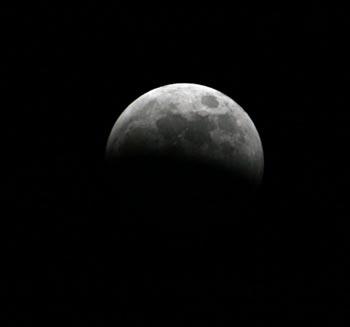 |
| The Moon |
Now, we need to compare the sizes of the two objects in our night sky, which is also called the Apparent Size. Luckily, we have a mathematical relationship for the same:
Apparent Size (in degrees) = 360 degrees*Diameter of the object/2*π *Distance from the object
Substituting known values of the moon,
Apparent size= 360*3.47*10^6/2*π *3.84*10^8= approx. 0.5 degrees
Substituting known values for Mars,
Apparent size= 360*6.68*10^6/2*π *7.5*10^10= approx. 0.005 degrees
Comparing Apparent sizes,
Apparent size of Moon/ Apparent size of Mars= 0.5/0.005 = 100/1
Thus, the full moon is a 100 times bigger than Mars in the night sky even when Mars is at its closest point to the Earth.

 Bijaya's creations