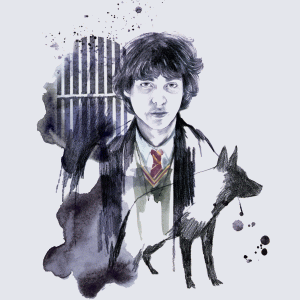
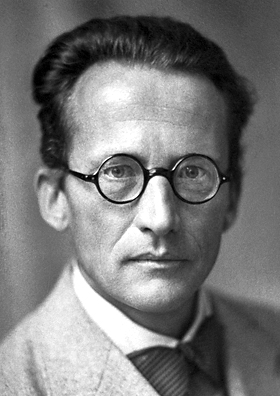
 Erwin Schrodinger is one of the founders of Quantum Mechanics and his birthday was yesterday, on August 12th. He was a nobel-prize winning Austrian and is most famous for one of the most dubious and noteworthy thought experiment: Schrodinger’s cat.
Erwin Schrodinger was an avid researcher and formulated the wave theory in quantum mechanics. He also made contributions to statistical mechanics, theoretical biology, general relativity and cosmology. He also took a keen interest in philosophy, and wrote a book entitled “What is life?”, in which he looks at the problem of genetics.
Erwin Schrodinger was born on 12th August 1887. He was born in Austria to parents who were quite well educated, and he also had links with the British through his mother. His theory of wave mechanics is now one of the anchor points of Quantum Mechanics. He also sought a theory of everything, which he called the Unified Field Theory. He received the Nobel Prize for Physics in the year 1933 for his work on wave mechanics.
However, he remains well known in the general community not for his field equations, but for his thought experiment dubbed “the Schrodinger’s cat”, which he devised in 1935. In this thought experiment, the cat is both alive and dead at the same time. This may seem counter-intuitive, but consider this: Everything is both a particle and a wave, two fundamentally different things, at the same time. This has been proved by experimental analysis and is called the “Wave-particle duality.” This is what Schrodinger himself said about the Cat:
Schrodinger remains to this day, one of the most inspirational scientists to have ever lived.

 Bijaya's creations