
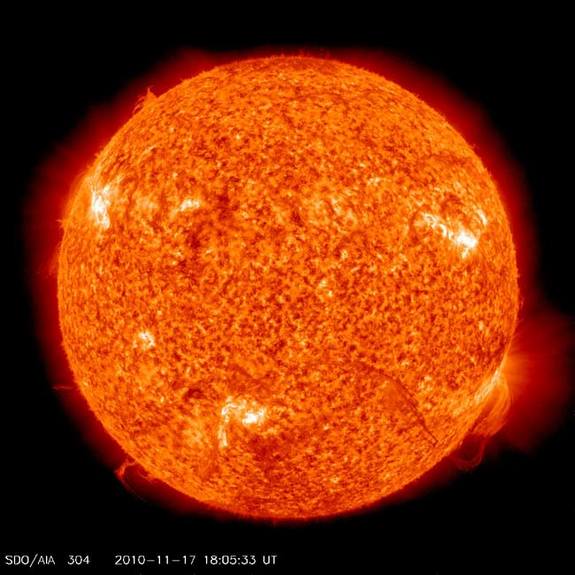
So, what is the Solar System? It is the region in space where the Sun is dominant. The Solar System is held together by the Sun, and it accounts for 99% of it’s mass. What is the Sun? The Sun is a G-type man sequence star that was formed roughly 4.6 billion years ago. The planets, asteroids, moon, comets and all matter in the Solar System was forged at the time, along with our Sun. It is thought that a Supernova explosion nearby provided a kick-start to the cloud of Hydrogen and Helium gas that was shrouding the locality where the Solar System is currently present.
The Sun started converting Hydrogen into Helium when temperatures in its core reached about 10 million degrees Celsius. For this, it had gathered large amounts of matter and shone with an orangish-yellow twinge. The planets themselves were made from the left-overs which didn’t clump into the Sun. Think about it. We are made from the left-overs of the gas that didn’t make up our Sun.
The Planets formed roughly 4.5 billion years ago, and this was not a good time to be living on the Earth (not that there was life on Earth at the time anyway!). Planets were constantly bombarded by huge rocks! An impact of the Earth with a Mars-sized object is hypothesized to have created our moon. In those times, the moon was much more brilliant than it is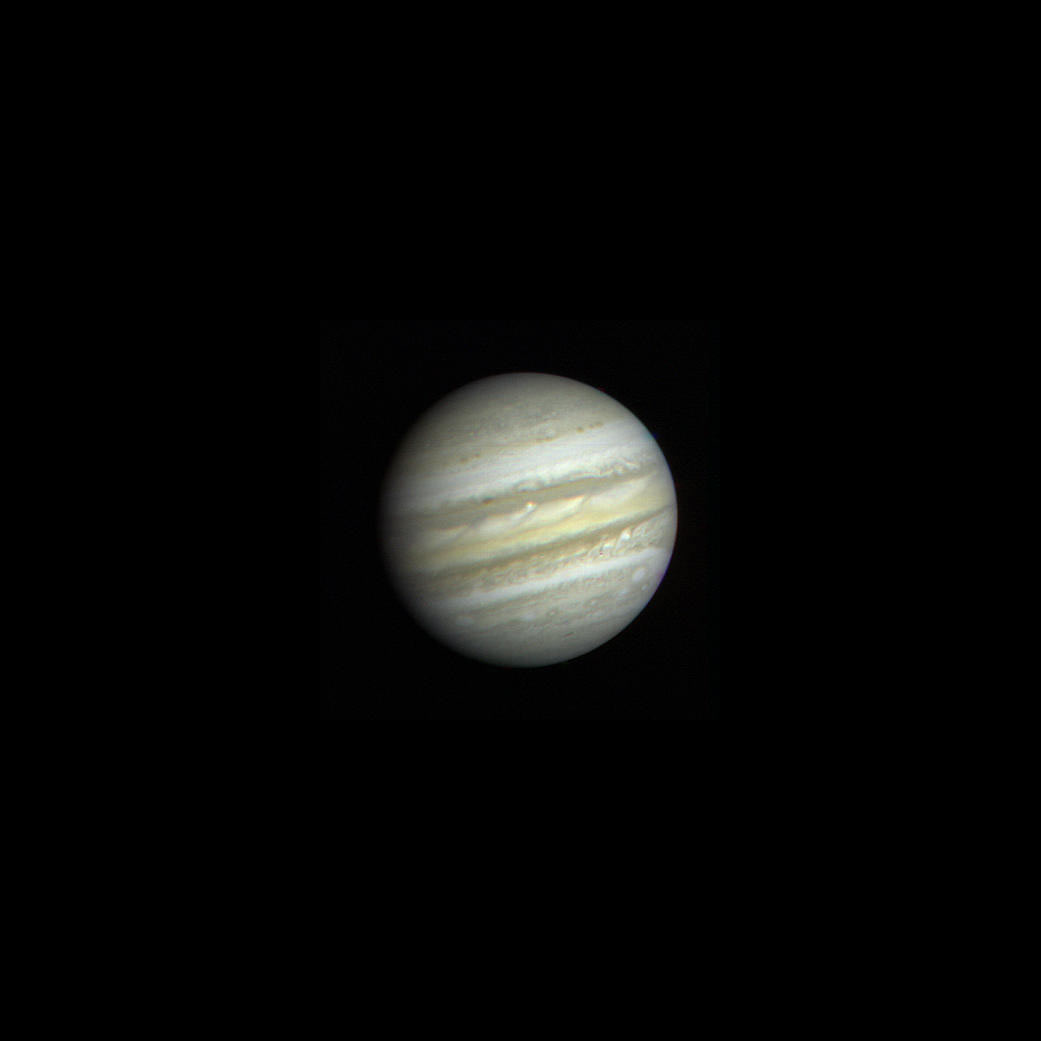 right now, because it was closer to us. However, due to the effects of gravity, the moon is slowly receding from the Earth, culminating sometime in he near future with the end of total solar eclipses.
Jupiter, the huge gas giant that dominates the rest of the Solar System, is about 315 times more massive than our Earth. Jupiter contains twice as much mass as all the other planets combined! It is a failed star. Had it been able to collect more Hydrogen in the past, there might well have been two stars in the Solar System- a binary star system, which is so common in our night sky.
The crown jewel of our Solar System is Saturn. It is the planet with the largest ring system. Mercury is the inner-most planet, and was responsible for the devising of the General Theory of Relativity, owing to small errors in its orbit, as predicted by Newtonian gravity. Venus, the nearest planet to the Earth, is Earth’s twin in size, but entirely different in nature. With a surface temperature of about 460 degrees Celsius, and a thick atmosphere,Venus is more of a frying pan than the wonderland that Earth is.
The Earth is the next planet and is the only one that is known to harbor life (though we may be proven wrong sometime in the near future). Mars is the next one. It is a desolate planet, which is predicted to have once had surface water.
After Mars comes the asteroid belt, the belt of asteroids; remnants from the youth of the solar system. Jupiter, which has such an immense gravity, prevents the remnants from forming a single planet. The Asteroid belt contains asteroids from sizes that of school buses, to that of Ceres, the largest object in the Asteroid belt, which has a diameter of about 950 km.
 After the asteroid belt lies Jupiter and Saturn. After them, Uranus and Neptune beckon. These are gigantic worlds in their own rights, and are blue in color due to the presence of Atmospheric methane and ammonia along with large concentrations of hydrogen and helium. After Neptune, lies
the Kuiper belt, which is a vast array of comets, which also contains Pluto, the dwarf planet.
After the Kuiper belt, there lies the scattered disk and further than that the Oort Cloud. The Oort cloud extends to about a light-year and this is the true size of the Solar System; the distances up till which the Sun’s gravity and influence is dominant.
The Solar System is a vast scale, but is nothing compared to the enormity of the cosmos. We are but a tiny drop in a vast cosmic ocean. This might serve as a humbling point the next time you might try to benefit from others.

 Bijaya's creations