
Let me begin with a little bit of background. In 1957, the first satellite to successfully orbit the Earth was launched by the soviets, Sputnik 1. It marked the beg
inning of a new era for life on Earth; humans were the first species to have ventured out from their home planet. Nevertheless, we could not have said that we have truly left the Earth, until and unless we send one of our own into the hostile and unforgiving place that is space.
 |
| Sputnik 1 |
Yet, even such a seemingly impossible task was achieved. In 1961, Yuri Gagarin became the first person ever to leave the Earth’s surface and orbit the Earth. This was a tremendous achievement in a very short amount of time. This sparked the US into life. Seeing the Soviets accomplish something of such caliber was painful for the Americans. John F. Kennedy, the then president of the United States of America, vowed to land a man on the moon and bring him back to the Earth safely by the end of the 1960s.
This even more unlikelier feat, given the tragedies such as Apollo 1, was achieved on July 20, 1969, when Neil Armstrong and Buzz Aldrin landed on the moon. Neil Armstrong’s quote, “Its one small step for a man’ One giant leap for mankind” has hitherto, became famous. The pictures that returned from these epic Odysseys gave a sense of awe to all human beings.
By the end of the twentieth century, robotic probes sent by man, had ventured into many parts in the Solar System. Our knowledge of astronomy, rocket science and theoretical physics has increased exponentially in the past century. We have been alerted to grave threats such as Global Warming, Asteroid Impacts, diseases and more due to the efforts of scientists in understanding our world. This has led to one conclusion: Life on Earth, of any kind, is not permanent and faces a demise after a certain span of time.
Does this hold true for human beings as well? Will there be no humans on the face of the Earth in the recent future? Possibly. Catastrophes such as Global warming are reaching levels where it is impossible to reverse the negative changes we have inflicted on our planet. Asteroids are being mapped and surveyed by astronomers of all sorts. This has led to a startling revelation: The timespan within which human beings are meant to dominate the Earth might be coming to an end. That is, if we stay on the Earth for a prolonged period of time.
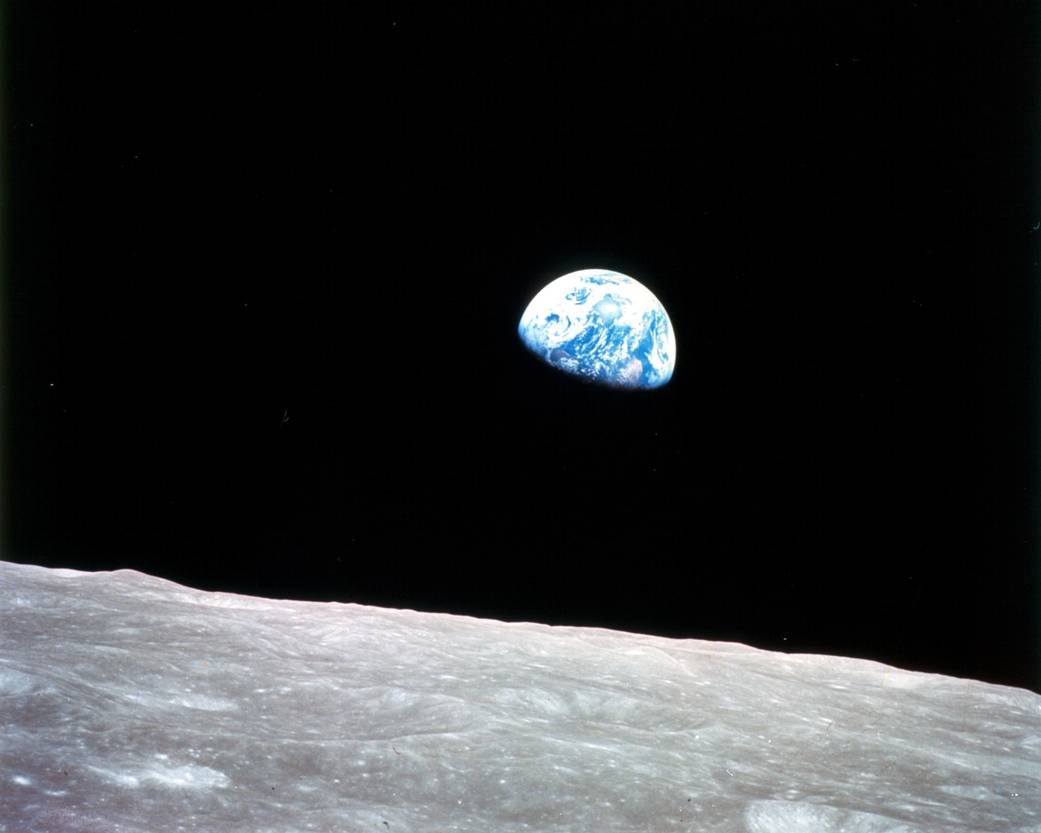 |
| Earthrise from Apollo |
This is where space travel comes into the picture. One can argue that space travel is expensive and wastes resources which can be used to curb environmental problems, malnutrition, poverty and other social issues. Yet, if we don’t invest in space travel soon, there might not be a human civilization that has to face and overcome these problems. Venturing out into space is not an easy task. One has to develop bases, find suitable candidates for colonization, and even look out for problems which can and will occur in such exotic environments. We are not yet ready to colonize another world.
But, it is of utmost importance to start taking small steps into the Cosmos. If we are to ensure the continued existence of the human species, we have to leave the Earth before its too late. Asteroid strikes that have the potential to cause widespread damage occur once every few millennia. Temperatures are rising to ecologically devastating levels. The Earth as we know it, is changing for the worse.
 |
| The Cosmos is vast |
We are responsible for ensuring our planet’s fate in such a manner. Yet, humans are capable beings and can learn from their mistakes. Thus, one can argue that colonizing another world will increase the sense of affection and gratitude towards the places that we live on.
We need to venture out into space and fast. Of course, we won’t be able to transverse distances the size of thousands of light-years anytime soon, but we have to try. Bigger things start by building upon smaller and smaller things. From our experiences on the planet Earth, we must learn from our mistakes committed here and not repeat them in the future. The fate of humanity now rests entirely upon developments in the 21st Century, something which has never happened in the history of our planet, and our species. Yet, I believe that we can overcome obstacles the size of the Great Wall of China and forge a human civilization that is outgoing and space-faring.

 Bijaya's creations